
Utilization Review. Medical Necessity Adjudication.
Inpatient medical necessity review and clinical appeals defense.
Active Utilization Review Openings (10)
Evaluate inpatient acute admissions, level of care, and surgical length-of-stay using InterQual clinical criteria and CMS Two-Midnight guidelines.
Review ongoing hospitalizations for Medicaid and Medicare Advantage enrollees against Milliman Care Guidelines (MCG) to support safe discharge planning.
Perform forensic chart audits on overturned or disputed medical claims. Prepare comprehensive clinical rationales for medical director dispute arbitration.
Weekend asynchronous chart review for emergency department observation vs inpatient placement. Shift differential applied.
Dedicated California HMO utilization management. Review complex tertiary and quaternary admissions for Northern and Southern California regions.
Review elective orthopedic, bariatric, and cardiovascular outpatient surgical requests against clinical coverage policies for Medicare Advantage members.
Manage inpatient psychiatric, residential treatment, and substance use disorder admissions using ASAM and MCG criteria.
Authorizations and level-of-care determinations for pediatric and adult Medicaid recipients. Ensuring compliance with state health department directives.
Flexible PRN schedule (15-25 hrs/wk). Review retrospective acute hospital claims and write comprehensive medical necessity appeal determinations.
Prepare clinical briefing packets for Medical Director peer-to-peer discussions. Coordinate overturned determinations directly with hospital CFOs.
The Core Mechanics of Medical Necessity Review
Remote utilization review (UR) jobs are specialized clinical roles where Registered Nurses evaluate hospital admissions, surgical procedures, and lengths-of-stay against evidence-based medical necessity criteria (InterQual and MCG). Operating for health plans or hospital systems from home offices, UR nurses ensure compliance with the CMS Two-Midnight Rule (42 CFR § 412.3) and prevent insurance denials, earning $82,000–$116,000/yr ($40–$56/hr).
Utilization Review (UR) and Utilization Management (UM) represent the operational checkpoint where clinical care intersects with healthcare finance and regulatory law. When an acute patient is admitted to a hospital, commercial health plans and Medicare Advantage payors do not automatically reimburse the resulting five-figure hospital invoice. Instead, certified clinical reviewers must authenticate that the patient’s condition genuinely warranted acute hospitalization rather than outpatient observation or ambulatory care.
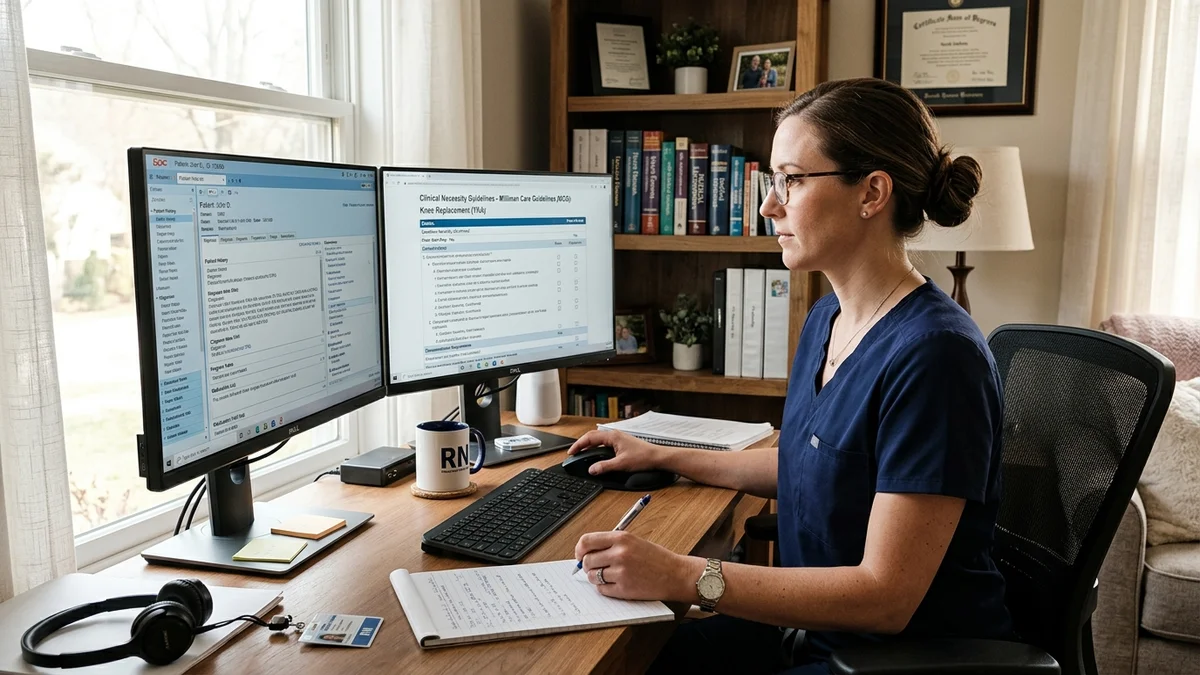
Registered Nurses in Utilization Review analyze diagnostic imaging, laboratory findings, vital sign trends, and physician progress notes within the Electronic Health Record (EHR). Utilizing evidence-based clinical algorithms, specifically McKesson InterQual and Milliman Care Guidelines (MCG), the UR nurse validates whether the patient meets objective intensity-of-service (IS) and severity-of-illness (SI) benchmarks.
InterQual vs. MCG: The Two Dominant Clinical Rule Sets
In modern healthcare administration, virtually all medical necessity reviews rely on one of two proprietary clinical decision engines:
1. McKesson InterQual: Built on structured algorithmic clinical subsets. Reviewers check specific physiological thresholds (e.g. oxygen saturation < 90% on room air, hemodynamic instability, IV medication requirements). Widely utilized by commercial payors and Medicaid managed care programs.
2. Milliman Care Guidelines (MCG): Emphasizes inpatient versus observation determinations, benchmark lengths-of-stay, and discharge readiness criteria. MCG is heavily favored by Medicare Advantage payors and integrated health systems.
CMS Two-Midnight Rule Adjudication (42 CFR § 412.3)
Federal regulations governing Medicare Part A reimbursement are anchored by the CMS Two-Midnight Rule (42 CFR § 412.3). Under this mandate, hospital admissions are generally appropriate for inpatient status only if the admitting physician expects the patient to require hospital care spanning at least two midnights, supported by contemporaneous medical documentation.
Remote concurrent review nurses monitor patient arrival timestamps in real time. If a patient receiving surgical care or observation services approaches the second midnight without meeting inpatient medical necessity, the UR nurse collaborates with the hospital case management team to prevent billing non-compliance.
The Escalation Protocol: Physician Advisor Collaboration & Peer-to-Peer Defense
A vital regulatory safeguard embedded in URAC and NCQA accreditation standards is that registered nurses cannot unilaterally issue a medical necessity denial. If clinical documentation fails to meet InterQual or MCG criteria, the UR nurse prepares a clinical summary and escalates the case to a board-certified Physician Advisor or Medical Director.
The Physician Advisor conducts a secondary review and may initiate a Peer-to-Peer (P2P) telephone conference with the attending hospital physician. The UR nurse’s synthesis of clinical facts (identifying confounding comorbidities, lab trends, and failed outpatient therapies) directly arms the physician advisor to defend legitimate coverage determinations.
📥 Download the 2026 Remote RN Resume & ATS Keyword Checklist
Includes essential InterQual and MCG clinical keywords that trigger positive scoring in healthcare ATS platforms.
Download Checklist (Print / PDF) →Frequently Asked Questions About Utilization Review Nursing
01 What is the difference between InterQual criteria and Milliman Care Guidelines (MCG)?
Both InterQual (owned by Change Healthcare / Optum) and MCG (owned by Hearst Health) are proprietary evidence-based clinical decision support tools used by hospitals and health plans to determine medical necessity. InterQual is structured as an objective clinical checklist (subset guidelines), whereas MCG emphasizes clinical indications, benchmark lengths-of-stay, and optimal recovery milestones. Major health plans typically mandate mastery of one or both systems.
02 What is the CMS Two-Midnight Rule (42 CFR § 412.3) and why is it important in UR?
The CMS Two-Midnight Rule establishes that hospital admissions are generally appropriate for Medicare Part A payment if the admitting physician expects the patient to require medically necessary hospital care spanning at least two midnights. Utilization review nurses monitor patient arrival times, severity of illness, and expected stay duration to ensure admissions are properly classified as observation versus formal inpatient.
03 Can I learn InterQual or MCG without hospital sponsorship?
While direct software access requires enterprise licensing, nurses can gain competitive familiarity through introductory courses offered by the American Case Management Association (ACMA), National Association of Healthcare Quality (NAHQ), and specialized continuing education modules. Highlighting understanding of clinical necessity principles on your resume is often sufficient for entry-level UR interviews.
04 What happens when a remote UR nurse cannot approve an inpatient admission?
Under federal regulations and URAC accreditation standards, Registered Nurses cannot issue a final clinical denial. If clinical documentation does not satisfy InterQual or MCG criteria, the UR nurse must escalate the case to a licensed Physician Advisor or Medical Director. The physician advisor conducts a secondary review and may initiate a Peer-to-Peer (P2P) telephone discussion with the attending hospital physician.
05 What are typical salaries and schedules for remote Utilization Review RNs?
Remote Utilization Review nurses earn between $82,000 and $116,000 annually ($40.00 to $56.00 per hour). While the majority of roles operate Monday through Friday during standard business hours (8:00 AM to 5:00 PM EST), concurrent review teams at large health plans also hire for weekend and holiday rotations with shift differential bonuses.